Top Doctor: I've Treated Thousands of Rabbits. The Ones That Died Young Had One Thing in Common. Nobody Wanted Me to Say It.

A retiring exotic-animal specialist breaks her silence on what the pet industry has never told rabbit owners — and why millions of rabbits are paying the price.

I'm going to tell you something I've kept to myself for 29 years.
Not because I didn't want to say it. But when you work inside a veterinary hospital — when you've got colleagues who consult for pet-industry brands, when your whole career depends on the system running smoothly — you learn pretty fast not to rock the boat.
I'm retiring this spring.
And for the first time in thirty years, I've got nothing left to protect. No colleagues to offend. No reputation to manage inside an industry with very specific opinions about what a vet is and isn't supposed to say out loud.
So here it is.
A question I've asked for 29 years
Every time. No exceptions.
When a rabbit comes into my exam room — lethargic, hunched over, not eating, that posture every rabbit owner dreads — there's one question I ask before I do anything else.
Not what they eat. Not when they last seemed normal.
I ask:
“How does your rabbit get its water?”
And almost every time, I get the same answer: “A bowl. I fill it every morning.”
Or: “A bottle. It's always full.”
I've heard those answers from loving, careful owners who did everything else right — the right hay, the right pellets, the right size cage, regular vet visits.
And their rabbit still ended up in my exam room anyway.
That's when I know what happened.
The experiment that changed everything
What I found when I started looking
Twelve years ago I had a three-week stretch of GI stasis cases that made zero sense. Different rabbits. Different breeds. Different diets. The one thing they all had in common: responsible owners doing everything by the book.
So I asked every one of them to send me a photo of their water setup. The bowl. The bottle. All of it.
Then I did something I'd never once thought to do in 20 years of practice.
I asked them to run a finger along the inside wall of the bowl. Not the bottom — the wall, right at the waterline, after it had been sitting out for a full day.
Every single one came back with the same answer.
“It feels a little slippery. Like there’s a thin film on it.”
That film has a name: biofilm.
It's a colony of bacteria that builds up on any surface sitting in still water. It starts within hours of filling a bowl. By 24 hours it's established. By 48 hours it's basically its own little ecosystem clinging to the walls — the kind soap and a quick rinse won't actually get rid of.
You can't see it. But you can feel it.
And here's the part nobody in this industry has ever had a reason to tell you: your rabbit can smell it from across the room.

100 million reasons
What your rabbit is reading that you can't
A rabbit's nose has up to 100 million scent receptors. Ours has about 6 million.
Right now, your rabbit is reading the air in your living room at a resolution you and I can't even imagine. It knows what you had for lunch. It knows if something walked past outside. And it knows exactly what's been going on in that water bowl since you filled it this morning.
What it smells isn't “fresh water.” It's:
- Bacterial biofilm building up on the bowl walls
- Fur and hay dust breaking down in the water
- Chlorine off-gassing as tap water sits at room temperature — something you'll never notice, but a sharp, unmistakable signal to a nose with 100 million receptors
Somewhere in that ancient brain — the brain of a prey animal that's survived for thousands of years by treating still water as a threat — something fires:
This doesn’t smell right. I’ll wait.
So your rabbit walks up to the bowl. Sniffs. Walks away.
You think it's being picky. It's actually telling you something's off with the water. And the “something better” never shows up — because you just keep refilling the same bowl.
Owners describe this constantly, without even knowing there's a name for it:
“He doesn't touch water that has even a little fur in it, or that's been sitting out for a few hours while I'm at work.” — Reddit r/Rabbits
“I give them fresh water every day but hair, hair and other stuff gets into their bowls regardless.” — Reddit r/Rabbits
The silence that kills
What your rabbit will never tell you
This is the part I find hardest to get owners to understand — and it's exactly what makes this so dangerous.
Rabbits are prey animals. Millions of years of evolution taught them one rule above everything else: never show weakness. A sick rabbit, a thirsty rabbit, a rabbit in pain — in the wild, that's a rabbit that gets eaten. So they learn from birth to hide every sign of it.
Your rabbit isn't going to limp over to you whimpering because it's thirsty. It'll just quietly drink less than it should. Every single day. Building up a deficit you can't see from the outside.
And by the time you notice — hunched in a corner, not eating, not moving right — you're usually already in an emergency.
GI stasis can turn fatal in 24 to 48 hours.
Owners who've been through it describe it in almost the exact same words:
“My rabbit had mild GI stasis twice in two years. I think the fact that she doesn't drink much hasn't helped prevent it.” — Reddit r/Rabbits
“I didn't realize it and my rabbits went without water for a day and a half. I felt awful.” — Amazon review
“I don't want to leave him alone while I go to work and have him be without water because he tossed it over and my roommates didn't notice.” — Reddit r/Rabbits

Follow the money
Why no one in this industry had a reason to fix it
I want to be clear about something: I'm not talking about some conspiracy in a boardroom somewhere. I'm talking about something way more ordinary — and honestly, way more damaging.
Nobody in the pet industry has ever had a financial reason to tell you the bowl is the problem.
A ceramic bowl costs two bucks. It's in every starter kit, every beginner care guide, every shelf at the pet store. The company selling it doesn't owe you an explanation. It just needs to be sitting there when you check out.
So that's what's been sitting there for 50 years. Not because it's right. Because nobody's ever had a reason to change it.
Go check the website of any major pet fountain brand and search “rabbit.” You won't find it.
PetSafe. Petlibro. Catit. These companies have made millions off fountain technology that could genuinely help rabbit owners. And not one of them has bothered to build anything for an actual rabbit. The rabbit market's too small. The numbers don't justify a redesign.
So what happens? Rabbit owners buy cat fountains. And cat fountains fail rabbit owners in every predictable way:
- They're built for cat height. Most stand about 7–8 inches tall. For a Netherland Dwarf or a mini lop, that's a stretch. “Everything I find online seems to stand too tall to be comfortably accessible, especially for my Nethie.” — Reddit r/Rabbits
- They have cords. And rabbits chew cords. That's not an “if.” It's a “when.” “Our rabbit had a fountain. It broke when he chewed the wire.” — Reddit r/Rabbits
- Their pumps die. “The pump broke within 6–9 months.” — PetSafe Drinkwell. “Quit working after 4 months.” — PetSafe Pagoda. “Now it won't work.” — Petlibro.
“I’ve bought about five water fountains for my rabbit and so far this was the best one.”
Reddit r/Rabbits
Five fountains. Five rounds of throwing money at cat solutions, hoping one finally survives.
Meanwhile, one person documented how they protected their fountain's cord from their rabbit. They cut a metal pipe with a hacksaw and ran it around the cable.
A hacksaw. For a water bowl.
That's what happens when an entire industry decides your market isn't worth bothering with.
Claire and the two Ollies
The story I think about every time I write a prescription
About ten years ago, a woman named Claire walked into my exam room.
She was a nurse — emergency department. The kind of person who doesn't panic, who researches everything, who'd read every rabbit forum and care guide out there before she ever brought her Holland Lop home.
His name was Ollie. Three and a half years old.
She was crying before she even sat down.
Ollie had been declining for two days — quietly, no drama, the way rabbits do. By the time she noticed, he was hunched in that posture every rabbit owner learns to dread.
Advanced GI stasis.
We did everything we could. Fluids, medication, assisted feeding, heat support.
While I was placing the IV, I asked my question. “How does he get his water?”
“A bowl,” she said. “A beautiful ceramic one. I wash it every morning before work.”
“Does he drink well?”
She paused a beat too long. “I think so. Though… sometimes he walks up to it, sniffs, and walks away. I always figured he was just being picky.”
Ollie died that night.
Claire never found out exactly why. GI stasis has a dozen possible causes. No vet on earth can point to just one with certainty.
But I never forgot what she told me: He walked up to it. Sniffed it. Walked away.
A few months later, she sent me a card:
“I keep thinking about everything I could have done differently. You told me none of this was my fault — I’m still not sure I believe you. But I wanted you to know I adopted a new rabbit. The first thing I bought was a fountain. His name is Ollie too.”
From Claire’s card to Dr. Ellis
That second Ollie is nine years old now. Still comes in every year for his checkup.
I'm not going to sit here and tell you the fountain saved his life. I don't know that. Nobody does.
What I do know: in nine years, Claire's never once come home wondering how long her rabbit had gone without water. That's not nothing.

Eight years of recommendations
What I look for in a fountain. And why most don't qualify.
After Claire, I started recommending fountains to every owner who'd listen. But I got specific about it — because the wrong fountain just swaps one problem for another.
My list hasn't changed in eight years:
- Stainless steel, not plastic. Plastic scratches. Scratches harbor biofilm that soap can't reach.
- Moving water. Not a trickle. Constant circulation that breaks up the stillness where biofilm forms.
- No power cord inside the cage. Ever. Non-negotiable.
- Low and wide. Built for a rabbit's posture, not a cat's.
- Heavy base. Rabbits flip things.
- A filter that catches fur and hay before they reach the pump. This is what kills every cat fountain within months.
- Quiet enough to run all night. Rabbits don't go near things that make noise they don't recognize.
- Cleans in under five minutes. If cleaning it's a whole production, it ends up sitting in a drawer.
- A real return policy. Some rabbits just don't take to fountains. The only way to find out is to try.
For years, nothing on the market checked all nine boxes.
Then I found the Kelvoraa Wireless Rabbit Fountain.
Why this one
What the Kelvoraa has that nothing else does
304 food-grade stainless steel throughout. No plastic reservoir. No plastic smell. No surface that scratches and ends up harboring biofilm over time. The parts are dishwasher-safe and the whole thing comes apart without tools.
Moving water, no cord inside the cage. It runs on a rechargeable battery — charge it in the kitchen, your office, wherever — and put it back in the cage with zero cable anywhere near your rabbit. The cord never goes near the pen.
Low, wide bowl, heavy base. Built for small rabbits to drink in a natural position, with a base heavy enough to survive the kind of casual destruction rabbits specialize in.
Filtration that actually protects the pump. Fur and hay get caught in the filter, not the motor. That's exactly what kills cat fountain pumps within months — and it's exactly what this design prevents.
Whisper-quiet. Run it all night and nobody in the house will notice.
Cleans in under 5 minutes. Whoever designed this has clearly cleaned a fountain before.

Ready to give your rabbit water it actually trusts?
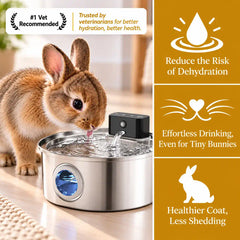
Wireless Water Fountain for Rabbits + FREE Gifts
$219.18$109SAVE 50%
60-day money-back guarantee
The questions I hear every time
What owners ask me. Answered honestly.
“What if my rabbit ignores it?”
It happens. Rabbits distrust new things — it's just how they're wired. That's why you don't pull the bowl on day one. Put the fountain next to the bowl, leave both running, and let your rabbit check it out at its own pace. Most come around within a few days. And you've got 60 days to find out.
“One of my rabbits took to it instantly. The other took three days.” — Reddit r/Rabbits
“What about the charging cable? Mine chews everything.”
The charging cable never goes anywhere near the cage. You charge the fountain outside the pen and put it back in fully charged. No cable at rabbit level, period. That's the entire point of running it on battery.
“My rabbit is tiny. Will it reach?”
It's built low and wide specifically because the number one complaint rabbit owners have about cat fountains is that they're too tall. If your rabbit can reach a bowl on the floor, it can reach this.
“His fur clogs everything. What about the pump?”
The filter catches the fur before it ever reaches the pump. During heavy shedding, just clean the filter more often — takes seconds. The pump itself stays protected the whole time.
“Fountain pumps die in three months.”
Cat fountain pumps die in three months because rabbit fur gets into the motor. This design stops that from happening. And it comes with a 60-day guarantee so you can see for yourself.
“A heavy ceramic bowl is fine. This is just marketing.”
For some rabbits, maybe it is. I'm not here to sell you something your rabbit doesn't need. What I am telling you: if your rabbit ever walks up to the bowl, sniffs, and walks away — if it's going long stretches without drinking while you're at work — the bowl isn't cutting it.
The 7-day transition
How to make the switch without stressing your rabbit
Days 1–2: Put the fountain next to the bowl, turned off. Leave the bowl right where it is. Let your rabbit check things out on its own terms.
Days 3–4: Turn the fountain on. Keep the bowl right next to it. If the sound spooks your rabbit, turn it off and try again the next day.
Days 5–7: Tuck a leaf of fresh herbs or a piece of leafy green near the fountain's edge. Curiosity takes it from there.
Once your rabbit's drinking from the fountain regularly — several days in a row — pull the bowl. Not before.
Black Friday offer
What's included. And the guarantee.
I don't recommend things based on price. I recommend them based on what they actually do.
But I've been doing this long enough to know cost is real. So I'll say this much: a single vet visit for a rabbit with urinary complications can run several hundred dollars before treatment even starts. A well-hydrated rabbit tends to cost you a whole lot less.
Right now the Kelvoraa Wireless Rabbit Fountain is 50% off for Black Friday, with 3 free gifts and a 60-day money-back guarantee.
That's 60 days to run the measuring-cup test, before and after. Plenty of time to let your rabbit explore it at its own pace. If it doesn't take to it, send it back. No questions asked.
Black Friday — 50% off
Water your rabbit actually trusts.

The only wireless rabbit fountain built for rabbit owners — not repurposed from a cat product.
$219.18$109SAVE 50%
- 304 stainless steel throughout — no plastic reservoir
- Cordless — charges outside the pen, nothing to chew
- Low, wide bowl with a heavy flip-resistant base
- Filter that catches fur and hay before they reach the pump
- Whisper-quiet — safe to run overnight
- Cleans in under 5 minutes, dishwasher-safe
- 3 free gifts included
- 60-day money-back guarantee
60-day money-back guarantee
One last thing
What I packed last
I cleared out my exam room last month. Thirty boxes. Twenty-nine years.
The last thing I packed was the wall of photos. Patients I'd treated. Some I'd saved. Many I hadn't.
There's a photo of the second Ollie in there. Taken at his last annual visit. The fountain's visible in the background, blurry but there, in Claire's living room.
In 29 years, I've learned the most powerful intervention is almost never the clinical one. It's the preventive one — the small, daily thing that just runs quietly in the background while you're at work, while you're asleep, while you're not watching.
Your rabbit can't tell you the water smells wrong. It can't tell you it walked up to that bowl and walked away three times today. It just quietly runs a deficit, day after day, until one day something's off.
By then, the question is what's still possible.
Right now, that question hasn't even come up yet. You're reading this before the vet visit, before the bloodwork, before the hunched posture in the corner.
That's the only time the preventive choice is actually yours to make.
I've never once met a rabbit owner who regretted giving their rabbit better water.
Don’t wait for the bloodwork.
Wireless Water Fountain for Rabbits + FREE Gifts
$219.18$109SAVE 50%
60-day money-back guarantee